
What Do the 2025 UAE Companies Law Amendments Mean for Your LLC?
The 2025 Companies Law amendments give mainland LLCs tools that used to require a free zone, an offshore vehicle, or a side agreement: multiple share classes, statutory drag-along and tag-along rights, and a path to move your company between the mainland and free zones. In force since October 2025, they make a mainland LLC a serious structure for taking on investment. Some mechanics still wait on Cabinet regulations, so the practical rule right now is: prepare your documents, execute what’s ready.
Key takeaways
- Federal Decree-Law No. 20 of 2025 amends the Commercial Companies Law and came into force in October 2025.
- Mainland LLCs can now issue multiple share classes, different voting, dividend and liquidation rights.
- Drag-along and tag-along rights now have a statutory basis, not just a shareholders’ agreement.
- A formal re-domiciliation path lets companies move between free zones and the mainland.
- The law also recognises non-profit companies for the first time.
- What to watch: several share-class mechanics await Cabinet implementing regulations, so some steps aren’t executable yet.
- Companies that don’t update their MOA and shareholders’ agreement risk statutory defaults overriding their existing terms.
What the 2025 Companies Law amendments changed
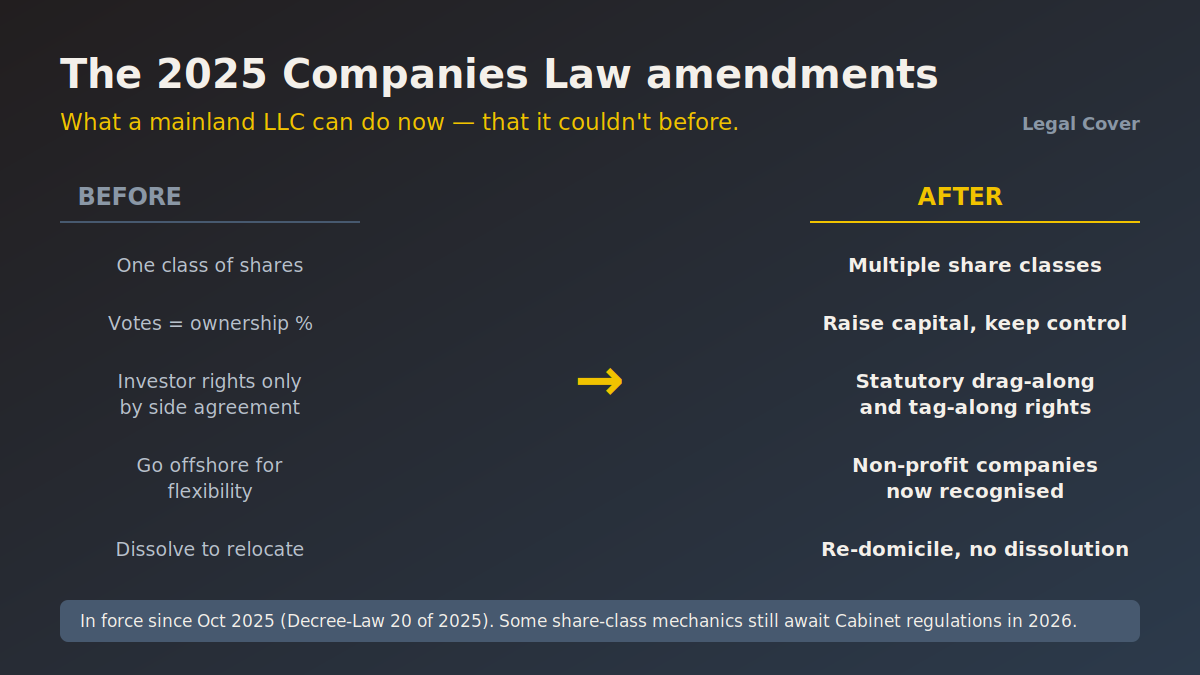
Until now, an onshore LLC was a blunt instrument. One class of shares, votes and profits tracking ownership in lockstep, and no clean way to let an investor put in money without handing over a matching slice of control. Founders who wanted anything more sophisticated went to a free zone, went offshore, or buried the real deal in a shareholders’ agreement sitting awkwardly beside the official documents.
The Companies Law amendments change that. For the first time, a mainland LLC can build the kind of capital structure that investors expect, bringing the onshore framework closer to what DIFC, ADGM and common-law jurisdictions have long allowed.
| Before | After the 2025 amendments | |
|---|---|---|
| Share classes | One class only | Multiple classes with different rights |
| Investor rights (drag/tag-along) | Contractual only, uncertain enforcement | Statutory basis |
| Raising money without ceding control | Hard — votes tracked ownership | Possible via non-voting or weighted shares |
| Moving between free zone and mainland | Dissolve and re-form | Formal re-domiciliation path |
| Non-profit company | Not recognised | Expressly permitted |
What can your LLC actually do now?
Three changes matter most to a growing business.
Multiple share classes. You can create classes with different voting, dividend, conversion and liquidation rights. That lets a founder raise capital while keeping control, or give an investor a liquidation preference, structures previously only clean offshore.
Drag-along and tag-along rights. These now sit in statute. Drag-along lets majority sellers compel minorities to join a sale to a third party; tag-along lets a minority join a sale on the same terms. Both make funding rounds and exits far more predictable.
Re-domiciliation. A company can move between a free zone and the mainland without dissolving and rebuilding, useful as your market access needs change.
What still needs to wait?
Here’s the honest part most headlines skip. The statute is in force, but the detailed rules for registering share-class categories sit in Cabinet-level implementing regulations that are still being finalised. The Ministry of Economy has signalled they’re expected during 2026. Until they land, the practical steps for some tools — non-voting shares in particular, remain partly unclear.
So the sensible move now is preparation, not rushed execution: get your constitutional documents and shareholder arrangements ready to use these tools the moment the mechanics are confirmed, rather than assuming every option is executable today.
What should you do about the Companies Law amendments?
One quiet risk sits inside these Companies Law amendments: where your Memorandum of Association and shareholders’ agreement don’t reflect the new framework, a court may apply the statutory defaults instead of your intended terms. Provisions you carefully negotiated could be set aside.
Practical steps: review your MOA and shareholders’ agreement against the amended law; identify where share classes or drag/tag-along rights would help your next raise or exit; and brief your shareholders on what changes for governance and exits. Do the groundwork now so you’re ready when the implementing regulations complete the picture.
How Legal Cover helps
These reforms are powerful and half-finished at the same time, genuinely useful, but easy to misread from a headline. We help UAE founders read the amendments against their actual structure, update the MOA and shareholders’ agreement so the new tools are available the moment they’re executable, and avoid the trap of statutory defaults overriding negotiated terms. All at a fixed monthly fee, handled by licensed UAE lawyers.
Planning a raise or bringing in a partner? Book a complimentary Legal Clarity Call and we’ll map what the new law lets your LLC do.
Can my mainland LLC issue different share classes now?
The statutory basis exists under the 2025 amendments, and you can prepare for it. Some detailed registration rules sit in Cabinet implementing regulations still expected in 2026, so confirm the current position before you file.
What are drag-along and tag-along rights?
Drag-along lets majority shareholders require minorities to join a sale to a third party on the same terms; tag-along lets a minority join a sale that a majority initiates. Both now have a statutory footing in the UAE.
Do I need to change my company documents?
If your MOA and shareholders’ agreement don’t reflect the amended law, statutory defaults may override your intended terms. Reviewing and updating them is the safe course.
Can I move my company between a free zone and the mainland?
The amendments introduce a formal re-domiciliation path, so a company can change its base without dissolving and re-forming. The available routes depend on the specific zones and activities involved.