

Can’t Pay Your Business Debts in the UAE? Your Options Before Bankruptcy
If your UAE business can’t pay its debts, bankruptcy is the last resort, not the first, and not the only option. The law now gives you court-supervised ways to keep trading while you settle with creditors. And the belief that missing a 60-day deadline is an automatic crime? That’s out of date. The real risk isn’t the deadline, it’s how directors behave on the way down.
Key takeaways
- UAE business insolvency runs on Federal Decree-Law No. 51 of 2023, in force May 2024, replacing the 2016 law.
- There are three routes: preventive settlement, restructuring, and bankruptcy (liquidation), in that order of preference.
- Preventive settlement and restructuring let you keep operating while you deal with creditors.
- Myth: missing the 60-day filing window is an automatic crime. The new law removed that automatic criminal liability.
- Real risk: directors can be personally liable for acts that harmed the company in the run-up to insolvency.
- It covers mainland companies and individual traders; DIFC and ADGM have separate regimes.
What happens if you can’t pay your business debts?
First, the reassuring part: insolvency in the UAE is no longer designed to punish a struggling business. Federal Decree-Law No. 51 of 2023 — the Financial Restructuring and Bankruptcy Law, with its own dedicated Bankruptcy Court, was built to rescue viable businesses, not just wind them up. It replaced the harsher 2016 regime and shifted the whole emphasis toward early, supported intervention.
So if your business debts have outrun your cash, you have real options short of shutting down — provided you act early. The businesses that come out the other side are almost always the ones that engaged while they still had room to manoeuvre, not the ones that waited for a creditor to force the issue.
The three procedures: settlement, restructuring, bankruptcy
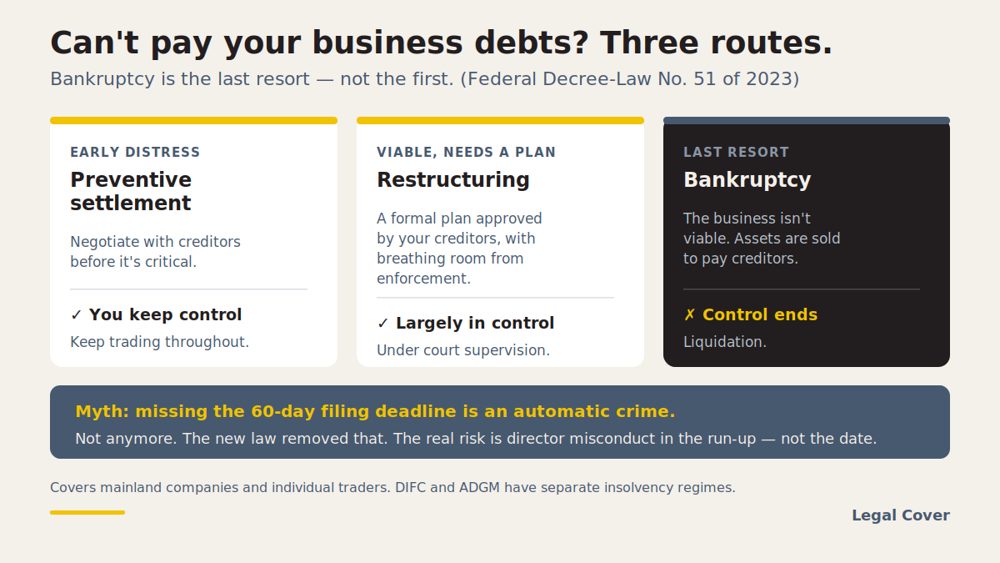
The law offers three routes, and the difference between them is how much control you keep.
| Route | When it fits | You stay in control? |
|---|---|---|
| Preventive settlement | Early distress, you want to agree terms with creditors before it’s critical | Yes — you keep running the business |
| Restructuring | The business is viable but needs a formal plan approved by creditors | Largely — under court supervision |
| Bankruptcy (liquidation) | The business isn’t viable and assets must be sold to pay creditors | No — assets are liquidated |
The order matters. Preventive settlement is the lightest touch: court-supervised, but you stay in possession and keep trading while you negotiate. Restructuring is a more formal plan for a viable business that needs breathing room from enforcement. Bankruptcy, liquidation, is the last resort, for when there’s no viable business left to save. Most owners jump straight to fearing the third when the first is what they actually need.
The 60-day myth: is late filing a crime?
Here’s the outdated belief still repeated everywhere: that a company must file within 60 days of stopping payments, and missing it is a criminal offence. Under the old law, that fear was real. Under the new one, it isn’t.
The current law gives a debtor 60 days from ceasing payments (or from realising it can’t pay) to apply, but it removed the automatic criminal liability for missing that window, and a late application is no longer automatically barred. The test shifted from the calendar to the substance: your actual solvency and conduct, not whether you hit a date. The point of the change was to encourage distressed businesses to come forward early instead of hiding, afraid of prosecution.
That doesn’t make the timeline irrelevant, acting early gives you far more options, but it does mean the deadline itself is not the trap owners think it is.
Are you personally liable for your company’s business debts?
This is the question that actually keeps founders up at night, and the honest answer is: usually no, but sometimes yes, and not for the reason you’d expect.
A limited liability company exists precisely to separate your personal assets from the company’s business debts. That protection holds in the ordinary case. What pierces it isn’t missing a filing deadline, it’s misconduct in the run-up to insolvency. The law lets the court examine directors’ and managers’ actions in roughly the two years before proceedings, and where their wrongful or negligent conduct caused the company’s shortfall, a court can order them to pay company debts personally. UAE courts have done exactly this.
The behaviours that create exposure: continuing to take on debt with no realistic prospect of paying, preferring some creditors over others improperly, hiding or disposing of assets, or trading on while plainly insolvent. In other words, personal liability comes from how you behave once you know you’re in trouble, which is exactly why getting advice early protects you personally, not just the company.
Facing business debts you can’t pay? What to do first
If you can see distress coming, a few steps protect both the business and you:
- Get a clear solvency picture — know whether the business is viable or not, because that decides which route fits.
- Engage early, while preventive settlement is still on the table and you keep control.
- Document your decisions — decisions made reasonably and on advice are your defence against personal-liability claims later.
- Don’t prefer creditors or move assets on instinct — well-meant moves here are exactly what courts scrutinise.
- Take advice before you act, not after — the window where options exist closes fast.
How Legal Cover helps
The difference between a business that restructures and one that’s liquidated, and between a director who’s protected and one who’s personally liable, usually comes down to how early they got advice. We help UAE businesses read their real position, choose the right route (settlement, restructuring or, if it must be, bankruptcy), deal with creditors, and protect directors from personal exposure. All at a fixed monthly fee, handled by licensed UAE lawyers.
Seeing business debts you’re not sure you can meet? Book a complimentary Legal Clarity Call before the options narrow.
Frequently asked questions
Do I have to file for bankruptcy if I can’t pay?
No. Bankruptcy is the last resort. Preventive settlement and restructuring both let a viable business deal with its debts while continuing to operate and the debtor can initiate them proactively.
What is preventive settlement?
A court-supervised procedure that lets a debtor in financial difficulty negotiate a settlement with creditors before the situation becomes critical, while staying in control of the business. It replaced the old “preventive composition” mechanism.
Can I be personally liable for my company’s business debts?
Generally your liability is limited to the company. But if a director’s wrongful or negligent conduct in the period before insolvency caused the shortfall, a court can order that director to pay company debts personally.
Does the bankruptcy law apply to free zone companies?
Mainland companies and individual traders are covered. DIFC and ADGM operate their own separate insolvency laws and courts, and banks and insurers fall under a separate CBUAE regime.
How long do I have to file?
Generally 60 days from ceasing payments or realising you can’t pay. Crucially, under the new law, missing that window no longer carries automatic criminal liability and doesn’t automatically bar your application — though acting early gives you more options.