

Selling to Consumers in the UAE? Your Legal Obligations Under the Consumer Protection Law
If your business sells anything to consumers, in a shop, through an app, or over social media, the UAE consumer protection regime applies to you, and some of the terms in your standard contracts are probably void. The law forces you to honour advertised prices, offer refunds on defective goods, disclose in Arabic, and respond to complaints. And any clause that tries to escape those duties is automatically null. The channel doesn’t change the obligation.
Key takeaways
- Consumer protection runs on Federal Law No. 15 of 2020 (amended in 2023) and its executive regulations.
- It covers all goods and services across mainland and free zones and online stores registered in the UAE.
- Any term that exempts you from your obligations, or harms the consumer, is automatically void, even in a signed contract or invoice.
- Core duties: honour advertised prices, provide refunds/exchanges on defects, disclose product info in Arabic, and honour warranties.
- Ignoring a complaint notice can trigger an automatic penalty.
- Fines reach AED 2,000,000, and there are 46 separate stipulated financial penalties.
Who does the UAE consumer protection law apply to?
Broadly, far more businesses than realise it. The regime covers all goods and services sold or provided by suppliers, advertisers and commercial agents across the UAE, including the free zones, per the UAE Government Portal. It reaches physical shops, service providers, and e-commerce platforms registered in the UAE alike.
The common misconception is that it’s about big retailers. It isn’t. A small F&B outlet, a boutique, a services business, a Shopify store registered here, all of it is in scope. The one meaningful boundary: the regime doesn’t reach e-commerce businesses that aren’t registered in the UAE, even when they ship to UAE customers.
What are your core obligations to consumers?
The law gives consumers a set of rights, which translate directly into duties on you:
- Honour advertised prices. The price you display is the price you charge, misleading pricing is one of the most-complained-about breaches.
- Refunds and exchanges. You must refund or replace defective goods, and refund where a paid-for service isn’t delivered.
- Disclose in Arabic. Product details, specifications, price and country of origin must be available in Arabic — this is mandatory, not optional.
- Honour warranties, and maintain a mechanism (in Arabic) for spare parts and maintenance where relevant.
- Recall and report defects. If you discover a defect, you must notify the authority and consumers, stop selling, and remedy it.
- Protect consumer data. You can’t repurpose customer data for marketing without proper consent.
The consumer protection clauses that are automatically void
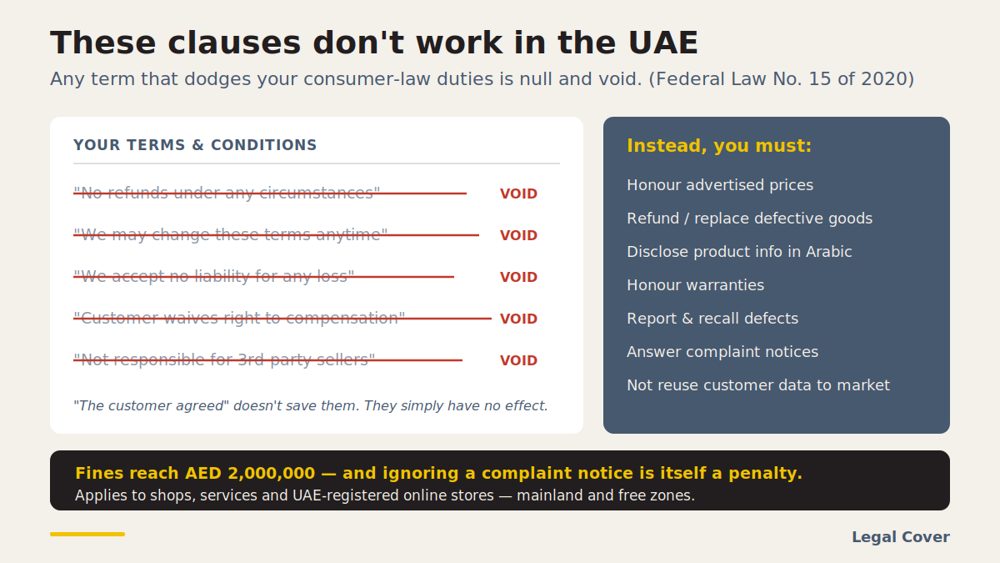
Here’s the part that catches businesses out, and the reason to re-read your own paperwork. Under the law, any term in a contract, invoice or other document that exempts you from your obligations, or is otherwise harmful to the consumer, is null and void. It doesn’t matter that the customer “agreed” to it, or that it’s written into your signed terms. It simply has no effect.
That quietly kills a lot of standard template language:
| Clause businesses often use | Status |
|---|---|
| “No refunds under any circumstances” | Void where the good is defective or service undelivered |
| “We may cancel or change these terms at any time” | Void as a unilateral, harmful term |
| “We accept no liability for any loss” | Void where it exempts you from legal obligations |
| “The customer waives any right to compensation” | Void, the right to claim compensation can’t be contracted away |
| (E-commerce) “We’re not responsible for third-party sellers” | Void, a platform is responsible for products sold through it |
If your terms and conditions were copied from a template or another market, assume some of this is in there, and that it won’t protect you.
What extra rules apply if you sell online?
E-commerce carries added duties. A UAE-registered online seller must give consumers the details of its licensing entity, product information and specifications in Arabic, and clear terms on payment, delivery and warranty. And critically, a platform is responsible for the products sold through it by third parties, any term trying to disclaim that responsibility is void. Selling through an app or social media doesn’t lighten the obligations; it adds to them.
What happens if you break consumer protection rules?
Enforcement is active and getting more so, UAE authorities logged tens of thousands of consumer complaints in 2026, with misleading pricing and refund refusals at the top. Breaches can draw fines up to AED 2,000,000 and, in serious cases, imprisonment, with penalties doubled for repeat offences. There are 46 separate stipulated financial penalties across the regime.
One trap deserves a specific mention: not responding to a complaint notice from the authority can itself trigger an automatic penalty. The complaints process isn’t optional, and silence is treated as a breach.
How Legal Cover helps
Most consumer-protection exposure is invisible until a complaint lands, and by then the void clause you relied on is already worthless. We help UAE businesses bring their terms and conditions, invoices and refund policies in line with the law, set up compliant e-commerce disclosures, and respond properly to complaints before they escalate. All at a fixed monthly fee, handled by licensed UAE lawyers.
Not sure your terms would survive a complaint? Book a complimentary Legal Clarity Call and we’ll review them.
Frequently asked questions
Does the consumer protection law apply to free zone businesses?
Yes. The regime covers all goods and services across the mainland and the free zones, plus e-commerce providers registered in the UAE. The main exclusion is foreign online sellers that aren’t registered here.
Can I limit refunds in my terms and conditions?
Not for defective goods or undelivered services. A blanket “no refunds” clause is void to the extent it exempts you from your legal obligations, regardless of what the customer signed.
Do I have to provide product information in Arabic?
Yes. Product details, specifications, pricing and country of origin must be available in Arabic. This is a mandatory disclosure obligation, not a courtesy.
Is my online store covered?
If it’s registered in the UAE, yes, with extra e-commerce duties around licensing details, Arabic disclosure, and responsibility for third-party sellers on your platform.
What are the penalties for breaching consumer rights?
Fines reach up to AED 2,000,000, with imprisonment possible in serious cases and penalties doubled for repeat offences. Ignoring an official complaint notice can trigger an automatic penalty on its own.