

Your Rights as a Business Tenant in Dubai: Rent, Eviction & Disputes
As a business tenant in Dubai, you have more protection than most owners realise, your landlord can’t raise the rent by any amount, can’t evict you without 12 months’ notice, and can’t act on a verbal warning. Dubai’s tenancy law caps rent increases, restricts evictions to defined grounds, and gives you a fast, affordable tribunal to enforce it all. Knowing the rules is what stops a landlord from bluffing you out of your premises.
Key takeaways
- Dubai tenancies run on Law No. 26 of 2007 (amended by Law No. 33 of 2008), covering commercial as well as residential leases.
- Rent increases are capped by the RERA Smart Rental Index, a landlord can’t raise rent freely.
- If your rent is within 10% of market average, no increase is allowed at all.
- Any rent increase or non-renewal needs 90 days’ written notice; eviction for owner-use needs 12 months’.
- Verbal, WhatsApp or SMS notice has no legal effect.
- Disputes go to the Rental Dispute Centre, fast and low-cost.
- The trap: the rent cap protects you at renewal, but a landlord can decline to renew and relet to a new tenant at market rate.
What protections does a business tenant have in Dubai?
Dubai tenancy law, Law No. 26 of 2007, as amended, governs the landlord-tenant relationship for commercial premises as well as homes, and it’s more tenant-protective than many business owners expect. Three protections matter most: your rent can only rise within the limits of the RERA Smart Rental Index, your landlord can only evict you on specific legal grounds, and every notice must be in proper written form. A landlord who threatens a big hike or a quick eviction is often relying on you not knowing this.
One condition underpins all of it: your tenancy contract must be registered on Ejari. Registration is what gives you the standing to enforce these rights.
How much can a landlord raise a business tenant’s rent?
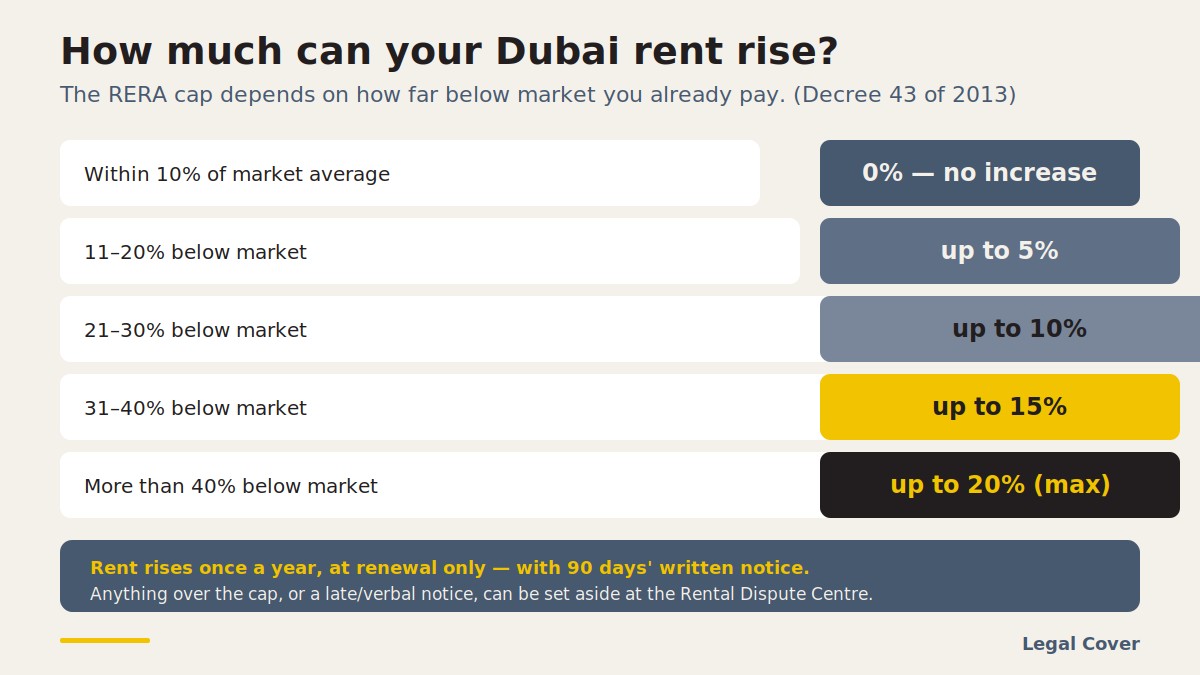
Not by whatever they like. Under Decree No. 43 of 2013, the permitted increase depends on how far your current rent sits below the average market rent for comparable units, measured by the RERA index.
| Your rent vs. market average | Maximum increase allowed |
|---|---|
| Within 10% of market average | 0% — no increase |
| 11–20% below market | Up to 5% |
| 21–30% below market | Up to 10% |
| 31–40% below market | Up to 15% |
| More than 40% below market | Up to 20% (absolute cap) |
Two rules protect you further: rent can rise only once every 12 months, at renewal, never mid-term, and the landlord must give 90 days’ written notice before renewal. A notice served late, or for more than the index allows, doesn’t bind you. Pull a fresh RERA index report before you accept any increase.
When can a landlord evict you or refuse to renew?
Only in defined situations. A landlord can’t simply remove a paying tenant. For non-breach reasons, eviction or non-renewal is limited to grounds such as the owner wanting to sell, use the premises personally, or demolish or substantially renovate, and each requires 12 months’ written notice through a Notary Public or registered mail.
Two points business tenants miss. First, a landlord cannot refuse to renew simply because you rejected an illegal rent increase, that’s a bad-faith move you can challenge. Second, for non-payment, the landlord must give a 30-day notice before starting eviction proceedings. Verbal or messaging-app notices carry no weight at all.
What if your landlord breaks the rules? The Rental Dispute Centre
Dubai gives you a dedicated tribunal: the Rental Dispute Centre (RDC), part of the Dubai Land Department, with jurisdiction over commercial and residential rental disputes: rent increases, eviction, deposits, maintenance and lease termination.
Filing is designed to be accessible: you submit your Ejari contract, the landlord’s notice, and your evidence (including the RERA index rating), and pay a fee of around 3.5% of the annual rent (with a floor and a ceiling). The RDC uses the same official index to rule, and cases move in weeks rather than years. For a business, that speed matters, it means a landlord can’t simply outlast you.
The trap every business tenant should know
Here’s the gap in the armour. The rent cap and renewal protections apply while you continue your tenancy. But a landlord is entitled to decline to renew, with the full 12 months’ notice, and then relet the premises to a new tenant at full market rate, because the cap doesn’t apply to new tenancies.
For a business that has invested in fit-out, signage and a location its customers know, that’s real exposure: you can be capped-and-protected one year and facing a market-rate reset or a move the next. The defence is at the drafting stage, renewal terms, option periods and notice mechanics negotiated into the lease before you sign, not argued about at renewal.
How Legal Cover helps
Most commercial-lease problems are winnable, tenants just don’t realise the rules are on their side until it’s late. We help UAE businesses check a rent increase against the index, respond to eviction and non-renewal notices, negotiate protective renewal terms into the lease up front, and run a Rental Dispute Centre case if it comes to that. All at a fixed monthly fee, handled by licensed UAE lawyers.
Facing a rent hike or a notice you’re not sure is legal? Book a complimentary Legal Clarity Call before you respond.
How much notice must a landlord give for a rent increase?
At least 90 days before the renewal date, in writing. A notice served later than that, or by verbal/WhatsApp/SMS message, doesn’t take effect for that renewal cycle.
Can my landlord increase commercial rent by any amount?
No. Increases are capped by the RERA Smart Rental Index based on how far your rent sits below market average, from 0% (within 10% of market) up to a maximum of 20%.
Can a business tenant challenge an eviction?
Yes. If the landlord hasn’t given proper 12-month notice through a notary, lacks a valid legal ground, or is acting in bad faith, a business tenant can challenge it at the Rental Dispute Centre.
Does the rent cap apply to commercial leases?
Law No. 26 of 2007 and the Rental Dispute Centre cover commercial tenancies. The index mechanics were designed around residential ratings, so confirm how the cap applies to your specific commercial unit.
What does it cost to file at the Rental Dispute Centre?
The filing fee is generally around 3.5% of the annual rent, subject to a minimum and maximum. You’ll also need your Ejari registration and the relevant notices and evidence.