
Almost every UAE company must file a UBO declaration, a record of the real person who ultimately owns or controls the business, with its licensing authority. New companies file within 60 days. You must report any change to ownership within 15 days. The obligation is ongoing, not a one-time setup task, and that is where most companies slip.
Key takeaways
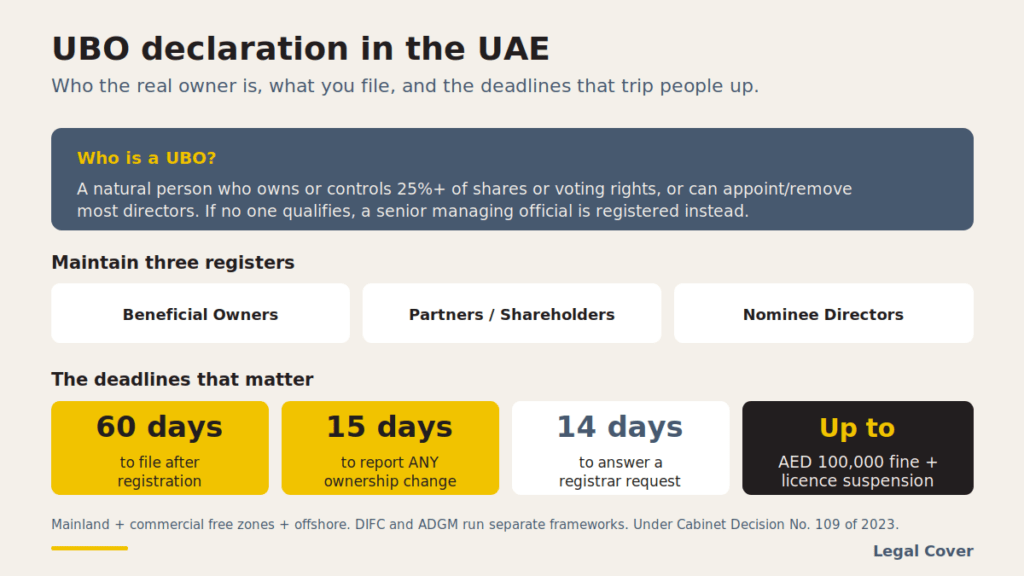
- A UBO is any natural person who owns or controls 25% or more of the shares or voting rights, or who can appoint or remove the majority of directors.
- Governed by Cabinet Decision No. 109 of 2023; penalties under Cabinet Decision No. 132 of 2023.
- Applies to mainland and commercial free zone companies, and offshore entities. DIFC and ADGM run separate frameworks.
- You must maintain three registers: beneficial owners, partners/shareholders, and nominee directors.
- New entity: 60 days. Any change: 15 days. Miss it and penalties escalate to fines and licence suspension.
- If no one hits 25%, a senior managing official is registered as the fallback.
What is a UBO declaration?
A UBO – Ultimate Beneficial Owner – is the real human being behind a company, not the holding company or nominee that may appear on the trade licence. Under Cabinet Decision No. 109 of 2023, administered through the Ministry of Economy and the licensing authorities, a UBO is any natural person who, directly or indirectly, owns or controls 25% or more of a company’s share capital or voting rights, or who has the right to appoint or dismiss the majority of its directors, or who otherwise exercises ultimate control.
If no individual meets that threshold, the company registers its senior managing official, for example the CEO or managing director, as the UBO by default. The point is that there is always a named natural person on record.
Who must file, and who is exempt?
The obligation is broad. It applies to:
- Mainland companies licensed by the Department of Economy and Tourism (or the equivalent authority in each emirate).
- Companies in commercial (non-financial) free zones, DMCC, IFZA, JAFZA, RAKEZ, Meydan, Shams and the rest.
- Offshore companies registered in UAE jurisdictions.
A few entities fall outside this framework: government-owned companies, listed companies with equivalent disclosure, and entities in the financial free zones (DIFC and ADGM). DIFC and ADGM still disclose, they just report under their own separate regimes.
What must you file, and by when?
Every company must prepare and maintain three registers and submit the beneficial-owner information to its licensing authority:
| Register | What it records |
|---|---|
| Register of Beneficial Owners | The natural persons who ultimately own or control the company |
| Register of Partners/Shareholders | The direct legal owners on the licence |
| Register of Nominee Directors/Managers | Anyone acting on behalf of another |
The deadlines are the part to burn into memory:
- File the initial declaration within 60 days of registration or licensing.
- Within 15 days of any change to ownership or control — update the register and notify the authority.
- Within 14 days of a registrar request — provide any additional information asked for.
- Keep the registers for five years after deregistration.
A “change” is wider than most owners assume. A new shareholder, a share transfer, a restructuring that shifts the ultimate owner, even a change in a director’s residential address – each one starts a fresh 15-day clock.
What happens if you don’t comply?
Enforcement under Cabinet Decision No. 132 of 2023 escalates. A first violation typically draws a written warning; repeated or serious non-compliance leads to fines rising to around AED 100,000 and, in serious cases, suspension of the trade licence. Since 2024 the authorities have moved to active enforcement and audits, and UBO data now feeds the UAE’s wider AML checks — which means banks and regulators see it during due diligence. Inaccurate or missing UBO records don’t just risk a fine; they can quietly complicate your banking.
The mistake most companies make
Not the initial filing, the updates. Companies treat UBO compliance as a one-time box at incorporation and then forgotten, so the 15-day change window is missed every time the cap table moves. Two more traps: using a nominee arrangement to obscure the real owner is a compliance failure, not a workaround; and PO box addresses are no longer accepted for a UBO’s residential address.
How Legal Cover helps
UBO compliance sounds administrative until a missed 15-day update surfaces during a bank review or an audit. We help UAE businesses map who their real beneficial owners are – including through indirect and multi-layer ownership – keep the three registers accurate, and file changes inside the deadline, at a fixed monthly fee handled by licensed UAE lawyers.
Not sure your UBO register reflects your current cap table? Book a complimentary Legal Clarity Call.
Who counts as a UBO in the UAE?
Any natural person who owns or controls 25% or more of the shares or voting rights, or who can appoint or remove the majority of the directors, or who otherwise exercises ultimate control. If no one qualifies, the senior managing official is registered instead.
Do free zone companies need to file a UBO declaration?
Companies in commercial free zones file through their free zone authority’s registrar. DIFC and ADGM companies report under their own separate frameworks rather than Cabinet Decision 109 of 2023.
How often do I need to update my UBO register?
Whenever ownership or control changes. Any change must be reported within 15 days. Many authorities also ask you to confirm the register at annual licence renewal.
Is UBO information public in the UAE?
No. The data is held by the registrar and is not publicly searchable. It is accessible to government authorities and, during due diligence, to banks and regulators.
What is the penalty for not filing?
Enforcement escalates from a written warning to fines and, for serious or repeated breaches, possible licence suspension under Cabinet Decision No. 132 of 2023.