

How Do You Recover Unpaid Invoices in the UAE?
When unpaid invoices sit for months, UAE law gives you a fast track most businesses never use: the payment order. If your debtor admitted the debt in writing, you can ask the court to issue an order in a matter of days rather than fight a full commercial claim for months. The catch is that it only works when your documentation is clean — and the longer you wait, the less likely you are to see the money.
Key takeaways
- The payment order is an expedited, ex parte route: the court can issue it within about three days of a properly prepared application.
- It only applies where the debtor established the debt in writing and the sum is specific and due.
- You must send a formal demand letter first, giving the debtor at least five days to pay.
- The debtor can challenge the order within 15 days but you can begin execution immediately.
- You can apply to freeze the debtor’s assets at the same time.
- Where the debtor genuinely disputes the goods or services, you file an ordinary commercial claim instead.
- Documentation decides everything. Businesses lose recoverable money by treating a receivable as an accounting problem until the debtor has restructured.
What do you need before you chase unpaid invoices?
Gather the paperwork before you spend a dirham on court fees. You carry the burden of proving the debt exists, fell due, and remains unpaid, so the file you assemble determines which route you can use.
Collect the contract or purchase order, the invoices, delivery notes, signed acceptance or completion certificates, account statements, and every email or WhatsApp message where the debtor acknowledged the amount. That last category matters more than most businesses realise: a written admission in an email thread can be the difference between the fast track and a full trial.
If you never signed a written contract, you can still recover. The courts recognise commercial practice, correspondence and conduct between the parties. It simply becomes an evidence-driven case rather than a contract-driven one, which takes longer and costs more.
What are the routes to recover unpaid invoices?
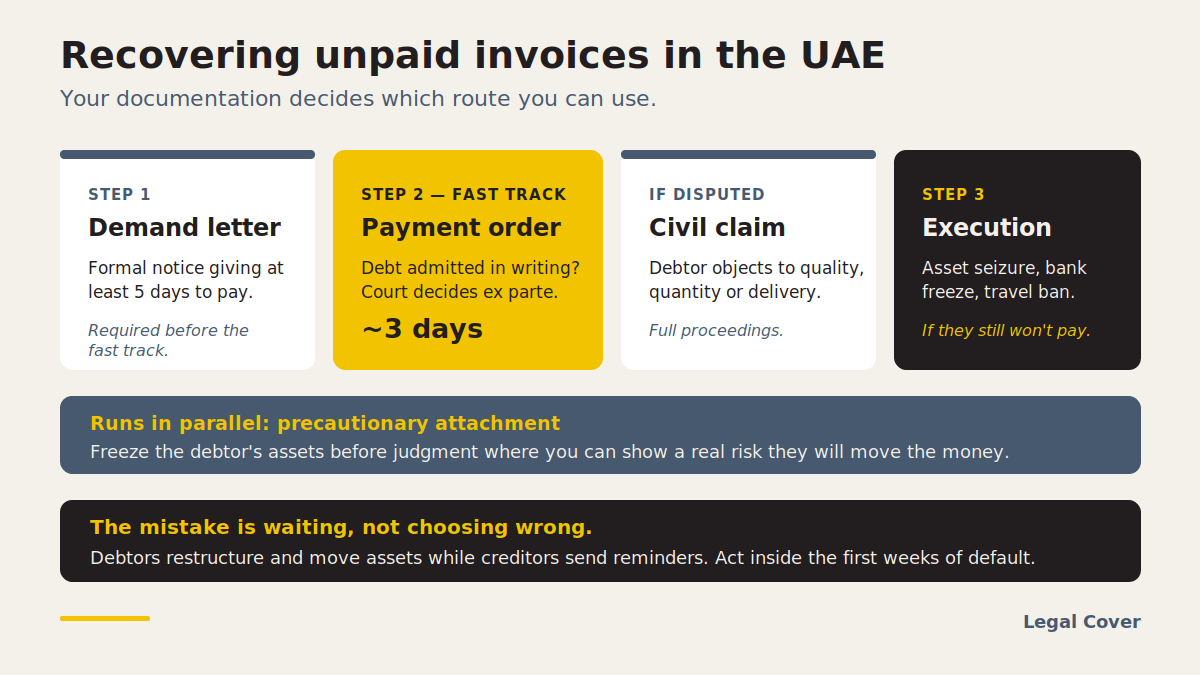
| Route | Use it when | What to expect |
|---|---|---|
| Formal demand letter | Always — it is a prerequisite for the fast track | Gives the debtor at least 5 days to settle; often resolves it |
| Payment order | The debtor admitted the debt in writing, sum is specific | Ex parte; court can issue in ~3 days |
| Civil or commercial claim | The debtor genuinely disputes quality, quantity or delivery | Full proceedings before the competent court |
| Precautionary attachment | You fear the debtor will move assets | Freezes assets; can run alongside the above |
| Execution proceedings | You hold an order or judgment and they still won’t pay | Asset seizure, bank account freeze, travel ban |
How does the payment order actually work?
This is the route worth understanding, because it turns a months-long dispute into a matter of days.
First, you serve a formal demand on the debtor requiring payment within at least five days. Then, if they don’t pay, you apply to the competent court attaching the demand, proof that you served it, and your documentary evidence. The judge reviews the application without the debtor present and, if satisfied, issues the order, commonly within around three days.
Two features make this powerful. The order carries expedited execution, so you can start enforcing it straight away rather than waiting out a challenge. And applying for it doesn’t stop you from also seeking precautionary measures against the debtor’s assets.
The debtor keeps the right to file a grievance, generally within 15 days of notification, and the court hears that challenge quickly. So the fast track is fast, not final but it puts the pressure squarely back on the debtor.
The limiting condition: the debt must be established in writing and be a defined sum. If your debtor raises a genuine objection to the quality, quantity or delivery of what you supplied, the court will send you down the ordinary claim route instead.
Can you stop the debtor moving the money?
Yes. Where you can show the debt and a real risk that the debtor will dissipate assets, you can apply for precautionary attachment, freezing bank accounts or securing property before you hold a final judgment. You can file it alongside a payment order or a civil claim.
This is the step businesses most often skip, and it’s frequently the one that decides whether a judgment is worth anything. Winning a case against a company that has already emptied its accounts recovers nothing.
Why most unpaid invoices never get recovered
Not choosing the wrong route, waiting. Companies treat unpaid invoices as a collections task for months, sending reminder after reminder, escalating politely. Meanwhile the debtor restructures, moves assets, or slides toward insolvency. By the time a lawyer sees the file, the practical chance of recovery has gone even where the legal right survives.
Two related traps. Informal pressure weakens you: aggressive messages and threats give the debtor something to use and prove nothing about the debt. And limitation periods apply, they vary by the type of debt and the parties involved, so confirm yours early rather than assuming you have years in hand.
The businesses that recover are the ones that act inside the first weeks of default, match the route to the quality of their paperwork, and check what the debtor actually owns before spending on court fees.
How Legal Cover helps
Most unpaid invoices never needed litigation, they needed a properly drafted demand and a credible next step, early. We review what your documentation will actually support, send the formal demand, apply for a payment order or attachment where it fits, and run the claim if it comes to that. All at a fixed monthly fee, handled by licensed UAE lawyers, which means chasing a debtor doesn’t start with a bill you’re reluctant to approve.
Sitting on invoices that should have been paid? Book a complimentary Legal Clarity Call and we’ll tell you which route your paperwork supports.
How quickly can you get a payment order in the UAE?
Once you have served the demand and filed a properly documented application, the court reviews it without the debtor present and can issue the order within roughly three days. Preparing the file properly is what takes the time.
Can I recover an unpaid invoice without a written contract?
Yes. The courts accept invoices, emails, delivery confirmations and the conduct of the parties as evidence. Without a contract the case becomes evidence-driven, so it usually takes longer and costs more.
Can I freeze my debtor’s bank account before I win?
You can apply for precautionary attachment where you show the debt and a genuine risk that the debtor will move assets. You can file it alongside a payment order or a civil claim.
What if the debtor disputes the invoice?
The payment-order route needs a debt the debtor established in writing. Where they genuinely dispute quality, quantity or delivery, you file an ordinary civil or commercial claim so the court can examine the evidence.
Can the debtor challenge a payment order?
Yes. The debtor can file a grievance, generally within 15 days of notification, and the court decides it quickly. Because payment orders carry expedited execution, you can usually begin enforcing while that runs.