

Will Registration in the UAE: DIFC, Dubai Courts or ADJD – Which Should You Choose?
Will registration in the UAE turns a will from a piece of paper into a document the courts act on. Without it, your family can face frozen accounts and a set of default rules you never chose. Non-Muslim residents can register through three routes: the DIFC Wills Service Centre, Dubai Courts, or the Abu Dhabi Judicial Department (ADJD). They are not interchangeable. The right one depends on where your assets are, whether you have children, and which language you want your will in.
Key takeaways
- Non-Muslim residents can register a will at the DIFC Wills Service Centre, Dubai Courts, or ADJD. ADJD also accepts Muslim wills.
- Federal Decree-Law No. 41 of 2022 gives non-Muslims far more freedom over their UAE estate. It does not remove the need to register.
- Without a registered will, the court decides: how your assets are distributed, and often who looks after your children.
- A will from your home country does not automatically cover your UAE assets or guardianship of children living here.
- If you have children under 18, naming a guardian in a registered will is one of the strongest reasons to register.
- All three registries offer online or video options, so you can usually complete the process without visiting in person.
- Review your will after marriage, divorce, a new child or a major new asset.
What does will registration actually do?
A will states who inherits your assets, who looks after your children, and who carries out your wishes. Registering it with a UAE authority puts it on an official record that courts and banks can rely on. Your family does not have to prove that it exists and is valid.
Federal Decree-Law No. 41 of 2022 on Civil Personal Status, in force since 1 February 2023, gave non-Muslim residents much more control over how their UAE estate passes on. The law lets you choose. Registering is how you record that choice, and the law does not remove the need to do it.
What happens if you die without a registered will?
Your estate goes where the rules say, not where you would have sent it.
- The court decides how your assets are distributed. It applies UAE default succession rules, or your home country’s law if someone can prove that law to the court’s satisfaction. Either way, the process runs slower and costs more than following a registered will, and fixed shares may not match your wishes.
- Bank accounts can freeze until the court settles the estate, which leaves your family without access to money during the process.
- The authorities may decide who looks after your children. If you have children under 18 and no named guardian, the courts and local authorities step in.
- Your family carries the cost and the delay at the worst possible time.
How do the three will registration routes differ?
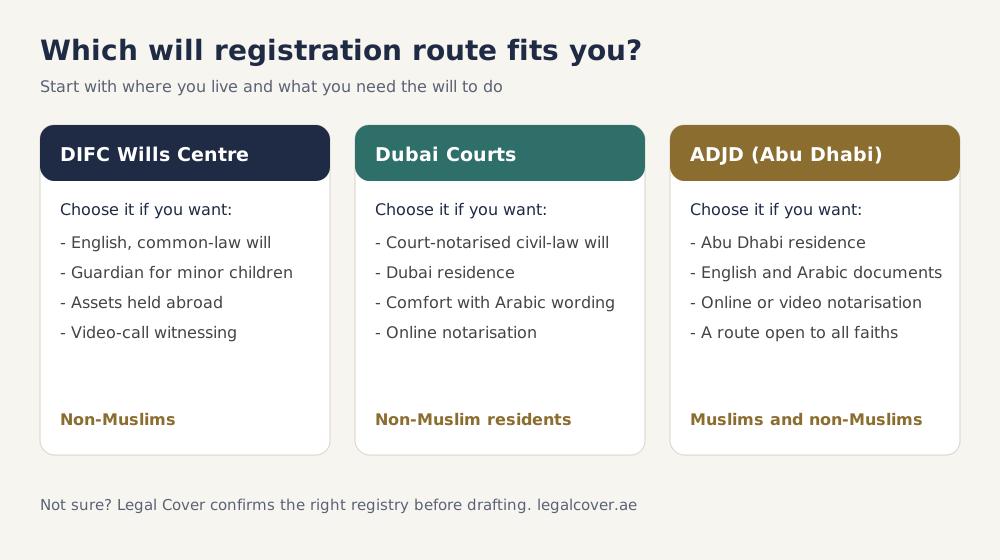
Each registry works under a different legal framework, and that shapes the language, the signing process and who can use it.
| DIFC Wills Service Centre | Dubai Courts | ADJD (Abu Dhabi) | |
|---|---|---|---|
| Legal framework | Common law, English-based | UAE civil law, notarised | UAE civil law |
| Language | English | Arabic (English drafts need translation) | English and Arabic |
| Open to | Non-Muslims | Non-Muslim residents | Muslims and non-Muslims |
| Signing | Two witnesses, video call allowed | The notary acts as the witness | Video notarisation available |
| Online option | Yes | Online notarisation available | Online submission |
A DIFC will drafted as a full will can also include assets you hold outside the UAE. That helps if you own property or accounts abroad.
Which registry should you choose?
The choice depends on your situation. Use these as starting points, not rules.
- Choose the DIFC Wills Service Centre if you want an English-language, common-law will, if you have minor children based in Dubai, or if you hold assets abroad. It is the most popular route among expats.
- Choose Dubai Courts if you live in Dubai and prefer a court-notarised, civil-law will, and you are comfortable with an Arabic document.
- Choose the ADJD if you live in Abu Dhabi, want bilingual English and Arabic documents, or need a registry that is open to both Muslims and non-Muslims.
If you are unsure, ask before you draft. Redoing a will for the wrong registry costs more than choosing right the first time.
What should your will cover?
A registered will works best when it answers the questions your family would otherwise argue about:
- Guardians for your children. Name a permanent guardian and a temporary one, and set out how you want your children raised. This stops the courts from deciding. Our wills and succession service covers guardianship in detail.
- An executor. Pick a trusted spouse, family member or professional to carry out your wishes.
- Your beneficiaries and assets, in the UAE and abroad, so distribution does not turn into a dispute.
- The right type of will. A single will covers one person. Mirror wills let spouses make matching arrangements, while each keeps a separate will that either can update alone. A blanket will covers your whole estate, current and future, so new assets are already provided for.
Business owners: what happens to your company shares?
If you own a company in the UAE, your shares are part of your estate. A will can say who inherits them, but your company’s own documents still matter: the Memorandum of Association, any shareholders agreement, and the licensing authority’s rules on transferring shares.
When those documents and your will don’t line up, your heirs can end up with shares they cannot easily transfer, a business partner they did not choose, or a company that stalls while the estate settles. If you are still deciding how to structure the company itself, start with our guide to mainland versus free zone, then make sure your will and your company documents tell the same story.
Common will registration mistakes
Most failures happen quietly, years before anyone needs the will.
- Assuming a home-country will covers the UAE. A foreign will does not automatically apply to your UAE assets or to guardianship of children living here. Registering a UAE will alongside it is usually safer, and the two need to work together instead of contradicting each other.
- Skipping will registration altogether. A will in a drawer is not a registered will.
- Choosing the wrong registry for your assets, language or children.
- Leaving conflicting wills at different registries without revoking the earlier one.
- Never updating it. Marriage, divorce, a new child or a new property can all change how your will reads, or whether parts of it still stand.
How Legal Cover handles will registration
We confirm which registry applies to your family, draft the right type of will (single, mirror or blanket), advise on guardianship and on how any foreign will fits alongside it, and arrange your notarisation. The whole process runs online, from the first conversation to the final step with the authority.
Not sure which registry fits? Talk to our wills team about your situation and we will point you to the right route.
Frequently asked questions
Do non-Muslim expats have to register a will in the UAE?
Federal Decree-Law No. 41 of 2022 lets you choose how your UAE estate passes on, but registering is how you make that choice count. Without a registered will, the court decides, and the outcome may not match what you wanted.
Can I register my will remotely?
Yes. Dubai Courts offers online notarisation, the DIFC allows witnesses to join by video call, and ADJD supports online submission and video notarisation. You can usually complete the process without attending in person.
Does my home-country will still count in the UAE?
Not automatically. A foreign will does not necessarily apply to your UAE-based assets or to guardianship of children who live here. Registering a UAE will alongside it is usually safer, as long as the two do not contradict each other.
What is a mirror will?
A mirror will is a pair of matching wills for spouses. Each partner keeps a separate will, so either one can update theirs later without affecting the other.